
Your Spreadsheet Died 18 Days Before Your Audit: Why STIG-Anchored CMMC 2.0 Just Killed Checklist Compliance
Your Spreadsheet Died 18 Days Before Your Audit: Why STIG-Anchored CMMC 2.0 Just Killed Checklist Compliance
Picture a compliance manager in June 2025, staring at a spreadsheet she’s maintained for eleven months. Every row color-coded. Every control mapped. Every POA&M item documented with dates and owners. She’s three weeks from her C3PAO assessment, and she’s confident.
She shouldn’t be.
Eighteen days before that assessment, her entire evidence package became obsolete. Not because she did anything wrong. Because the operational tempo of CMMC 2.0 shifted underneath her – and spreadsheets can’t keep pace with a compliance model that now demands continuous proof instead of periodic snapshots.
That shift isn’t hypothetical. It happened. And the defense industrial base crossed the threshold this week that makes it permanent.
The Granularity Nobody Saw Coming
Everyone fixated on the headline number. NIST 800-171 Rev 3 dropped from 110 controls to 97, and compliance teams exhaled. Fewer controls meant less work. Obvious math.
Wrong math.
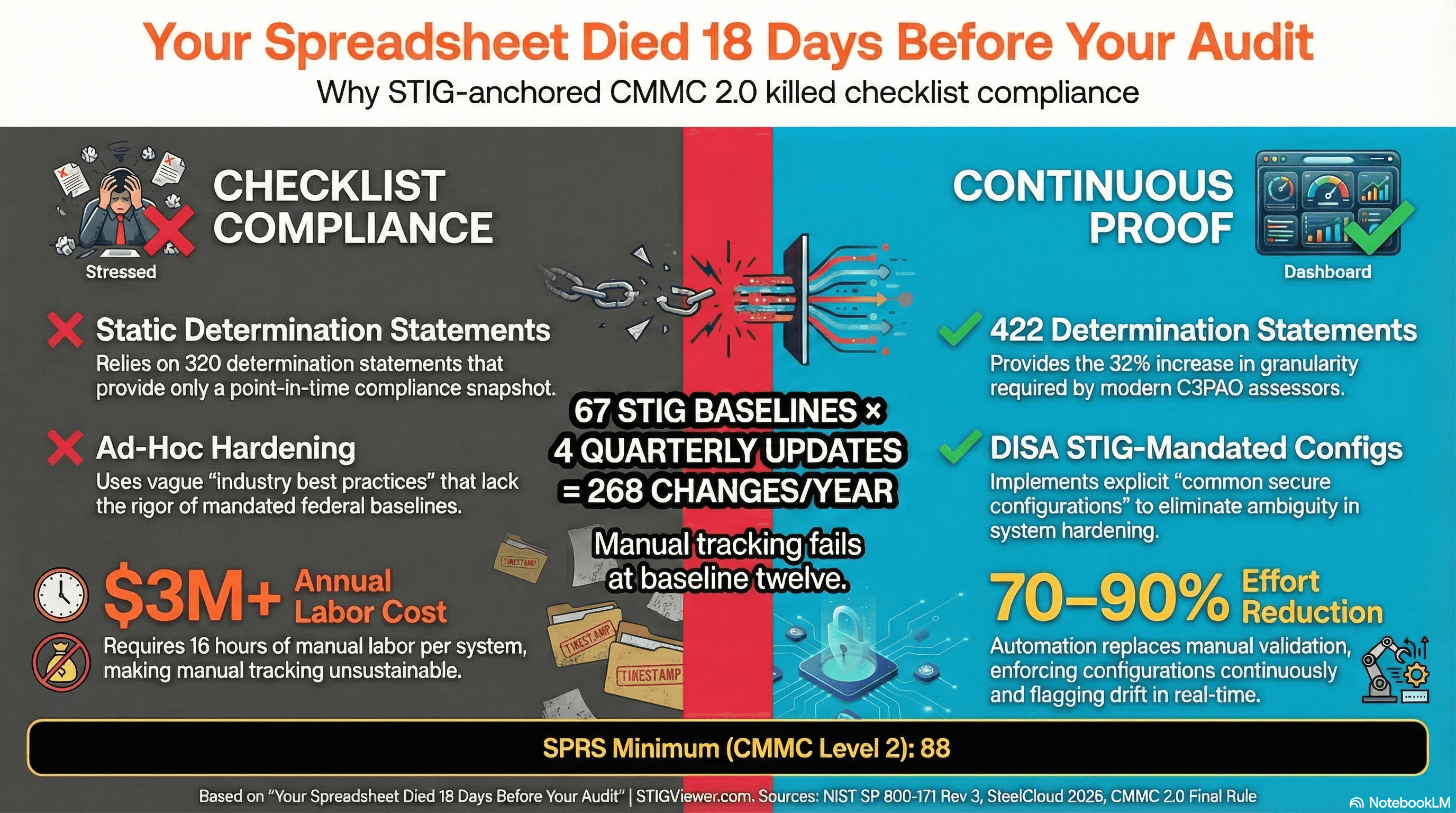
While organizations celebrated a smaller control set, assessors quietly gained 32% more verification granularity – expanding from 320 to 422 determination statements that C3PAOs now examine individually (NIST, 2024). The Department of Defense didn’t simplify compliance. They sharpened the lens.
But the real damage happened in two specific controls. Controls 3.4.1 and 3.4.2 now explicitly mandate “common secure configurations” rather than ad-hoc hardening approaches (NIST, 2024). That language shift matters more than most compliance teams realize. It eliminates the comfortable ambiguity that let organizations define their own baselines and call them sufficient.
You can’t wave vaguely at “industry best practices” anymore. You implement DISA STIGs, CIS Benchmarks, or equivalent vendor-published guidance – or you fail. Full stop.
And here’s where the operational math gets brutal. There are 67 active STIG baselines right now. Each one updates quarterly. That’s 268 configuration changes per year that must be tracked, implemented, and evidenced across entire infrastructures (SteelCloud, 2026). Not tracked in a spreadsheet. Tracked in systems that can prove compliance state at the moment an assessor asks – not the moment a compliance manager last updated a cell.
Manual tracking collapsed around the twelfth STIG baseline. That’s not opinion. That’s the operational reality every systems integrator managing heterogeneous environments discovered the hard way.
Self-Assessment Just Became a Legal Document
January 2026 changed what SPRS scores mean. Before, self-assessment was a planning exercise – organizations could submit aspirational numbers and attach POA&Ms promising future remediation. The minimum score for CMMC Level 2 now sits at 88, backed by verifiable evidence for every single control response (Cougias, 2026).
But the enforcement mechanism is what should terrify compliance officers. The False Claims Act applies strict liability to inaccurate self-assessments. Not negligence. Not “best effort.” Strict liability. That transforms a compliance spreadsheet from an internal planning document into a legally binding attestation where every number carries the weight of federal fraud statute.
Organizations can’t submit aspirational placeholders anymore. “We’re working on it” doesn’t survive a False Claims Act challenge. Either you can demonstrate the control operates effectively right now, or you’re misrepresenting your compliance posture to the federal government.
And the assessment model compounds this pressure. C3PAO assessments occur every three years – that part sounds manageable. But between formal audits, organizations must maintain continuously operating validation. Not quarterly reviews. Not monthly spot-checks. Continuous (MAD Security, 2026; CycoReSecure, 2026). The operational model flipped from 12-to-18-month sprint cycles culminating in point-in-time assessments to real-time compliance postures that assessors sample rather than build from scratch.
The $3 Million Answer Nobody Wanted to Hear
Organizations deploying unified automation platforms report 70-to-90 percent effort reductions and compress traditional 6-to-12-month timelines down to 100 days (SteelCloud, 2026). Those numbers sound like vendor marketing until you examine what they replace.
One systems integrator managing 2,500 endpoints had 20 full-time engineers spending 16 hours per system on manual compliance. Twenty people. Full-time. Doing configuration validation by hand across an infrastructure that drifts every time someone applies a patch, adds a user, or updates software (SteelCloud, 2026).
Automation didn’t just reduce that workload. It eliminated a $3 million annual cost while cutting error rates over 70 percent. Tasks that required weeks completed in hours. And the systems stayed compliant between assessments – not because engineers kept checking, but because automated platforms enforced configuration baselines continuously and flagged drift before it became a finding.
The unified platform model integrates STIG scanning, policy implementation, remediation, maintenance, and reporting into a single source of truth. That matters because the gap between approved policy and production configuration is where every audit finding lives. Manual processes create that gap. Automation closes it.
October 31, 2026: The Line in the Sand
Here’s the timeline that’s bearing down on the defense industrial base right now.
October 31, 2026 marks the inflection point when all new DoD solicitations require CMMC clauses. Phase 2 enforcement begins November 2026 (Accorian, 2026). After that date, self-assessment won’t be enough for Level 2. Third-party assessments become mandatory. And the compliance model evolves from checklist completion – “Did we implement 97 controls?” – to continuous proof of security effectiveness – “Can we demonstrate these 422 determination statements hold true right now?”
This shift operates across three layers simultaneously. STIG-anchored baselines provide the technical foundation that eliminates ad-hoc hardening variability. Automated platforms maintain configuration discipline as systems drift through routine maintenance, user additions, and software updates. Real-time dashboards replace retrospective audit preparation with prospective risk visibility that leaders can monitor continuously (TotalAssure, 2026; SteelCloud, 2026).
Plain-text policies are becoming machine-readable controls that automated systems enforce without manual translation. STIGs serve as the structured knowledge layer – 422 determination statements mapped to 156 security controls across 67 baseline configurations – that unified automation platforms operationalize at enterprise scale (Cougias, 2026).
The Battle That Isn’t Over
Organizations still maintaining spreadsheet-based compliance tracking face a reality that’s as brutal as it is simple: their evidence packages have an expiration date shorter than their audit preparation cycles. The manual audit-prep mindset can’t sustain the operational tempo that quarterly STIG updates, continuous monitoring requirements, and legally binding attestations now demand.
But automation isn’t a silver bullet, and anyone selling it as one is lying. The real battle isn’t manual versus automated. It’s whether defense contractors can transform their operational culture from “prepare for audit” to “maintain continuous security posture.” Tools help. Culture determines whether they work.
The era of checklist-driven compliance ended. Not with a policy memo. Not with a framework update. With the convergence of STIG-anchored baselines, automated enforcement, and legal liability that makes point-in-time assessment mathematically impossible to sustain.
The question isn’t whether your organization needs to make this shift. That’s already been decided for you. The question is whether you figure it out before October 31 – or whether your competitor figures it out first and takes the contract you were counting on.
Sources:
- Accorian. (2026). “CMMC 2.0 in 2026: What’s New and What Organizations Must Know.” https://www.accorian.com/cmmc-2-0-in-2026-whats-new-and-what-organizations-must-know
- Cougias, D. (2026). “CMMC Assessment Changes: STIGs, Automation, and Continuous Compliance.” LinkedIn. https://www.linkedin.com/posts/dcougias_cmmc-nist800171-stig-activity-7421659020295434240-yOPg
- CycoReSecure. (2026). “CMMC 2.0 and What It Means for Your Organization in 2026 and Beyond.” https://www.cycoresecure.com/blogs/cmmc-2-0-what-it-means-for-your-organization-2026-beyond
- MAD Security. (2026). “Five Steps to Achieve CMMC 2.0 Level 2 Compliance.” https://madsecurity.com/madsecurity-blog/cmmc-2-0-level-2-compliance-guide
- NIST. (2024). “SP 800-171 Rev. 3, Protecting Controlled Unclassified Information in Nonfederal Systems and Organizations.” https://csrc.nist.gov/pubs/sp/800/171/r3/final
- SteelCloud. (2026). “The Unified Automation Advantage for 2026 Cyber Readiness.” https://www.steelcloud.com/wp-content/uploads/WP-CyberReadiness2026-01.05.26OL-PP.pdf
- SteelCloud. (2026). “STIG Automation For Continuous DISA Compliance.” https://www.steelcloud.com/automate-disa-stig-compliance/
- TotalAssure. (2026). “Essential Guide: NIST SP 800-171 Configuration Management.” https://www.totalassure.com/blog/essential-guide-nist-sp-800-171-configuration-management