
Two Baselines, One Deadline: The STIG vs. CIS Decision That's Splitting Compliance Teams in Half
Two Baselines, One Deadline: The STIG vs. CIS Decision That's Splitting Compliance Teams in Half
You've been told to harden your systems. NIST 800-171 Revision 3 says so – controls 3.4.1 and 3.4.2 now demand "common secure configurations," and your CMMC Level 2 assessor is going to ask what baseline you chose. Not whether you chose one. *What* you chose.
So you pull up two tabs. Left side: DISA STIGs. Right side: CIS Benchmarks. Both claim to solve your problem. Both have defenders who'll argue loudly at conferences. And the decision you make in the next sixty days will determine whether your evidence package sails through assessment or gets kicked back with questions you can't answer fast enough.
Here's the part nobody tells you upfront: picking the wrong framework doesn't just waste time. It creates a gap between what your tools automate and what your assessor expects to see.
—-
The Promise That Started This Mess
DISA built STIGs for one audience: the United States Department of Defense. Military-focused baselines. Government-mandated login banners. Language crafted for warfighters protecting classified networks (Tufin, 2026). If you've held a DoD contract, STIGs aren't unfamiliar – they're the air you breathe.
CIS Benchmarks took a different path entirely. The Center for Internet Security builds its guidance through consensus – security practitioners, vendors, and organizations across industries hammering out recommendations that work for commercial environments, civilian government, and international organizations (MindPoint Group, 2026). Less doctrine, more democracy.
Both frameworks cover the expected terrain: Windows Server, RHEL, Ubuntu, macOS, Active Directory, VMware, Cisco gear. Both produce hardening guidance that maps to NIST controls. Both show up in assessor conversations.
But that's where the similarities end. And the differences? They'll cost you.
—-
Where the Fracture Lines Run
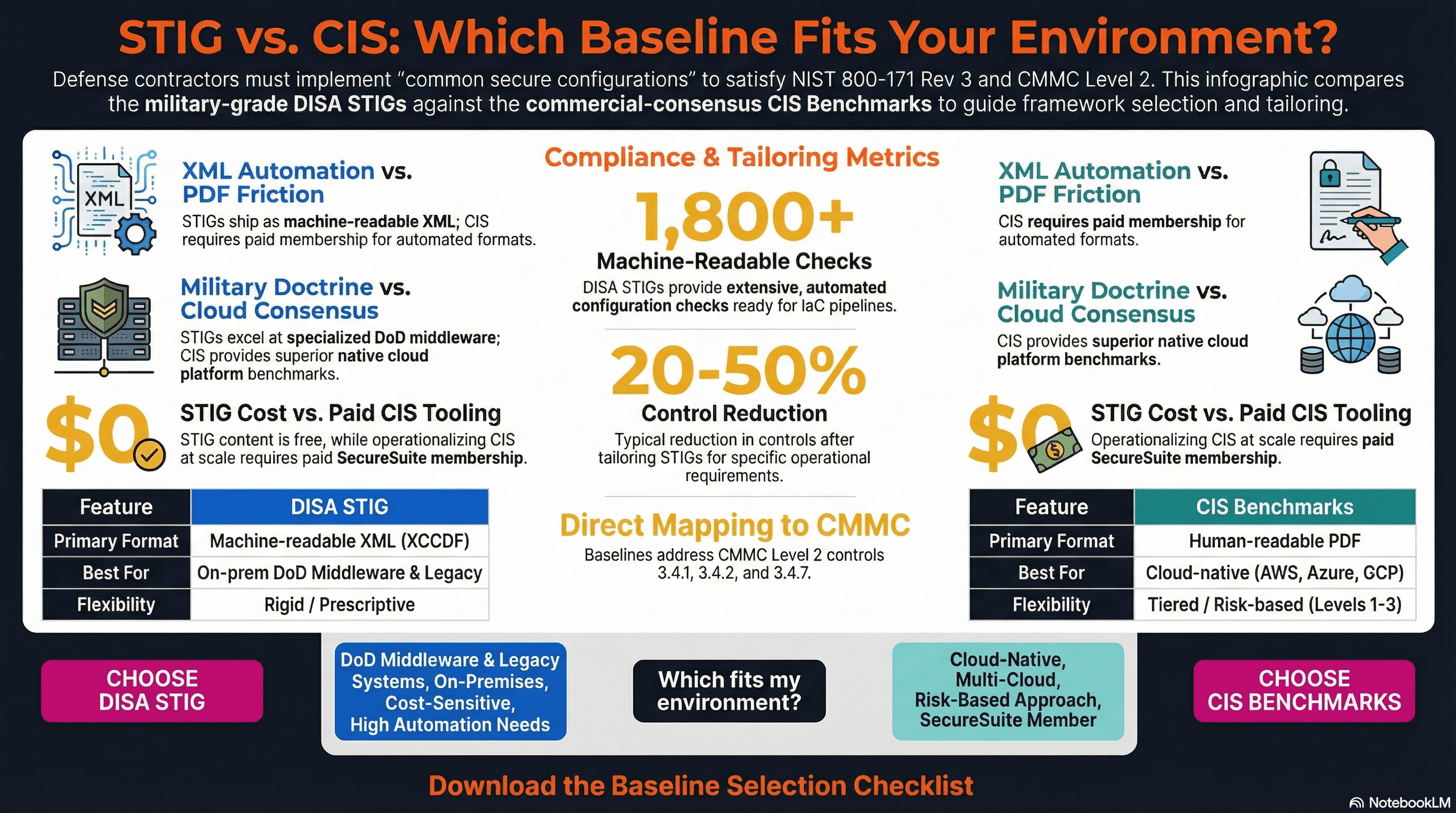
Start with coverage. DISA publishes product-specific STIGs for technologies like IBM WebSphere, Red Hat JBoss, and F5 BigIP – specialized middleware that CIS simply doesn't cover (MindPoint Group, 2026). If you're running legacy DoD infrastructure, STIGs give you prescriptive, line-item guidance. No interpretation required.
Flip the coin. CIS provides explicit benchmarks for AWS, Azure, and GCP – actual cloud platform guidance with actionable controls (MindPoint Group, 2026). DISA? They offer Security Requirements Guides for cloud. SRGs. Generic frameworks that *require interpretation and adaptation* before you can apply them. If your infrastructure lives in the cloud, you're writing your own implementation guide from DISA's starting point.
That's a practical decision, not a philosophical one. You run specialized DoD middleware? STIGs. You run cloud-native workloads? CIS. You run both? Welcome to the blend, and we'll get there.
Now add rigidity. STIGs don't negotiate. One Reddit thread captures the friction perfectly: a STIG mandates disabling Juniper's J-Web management interface *entirely*, but CMMC has no such requirement (Reddit r/CMMC, 2023). You could mitigate that risk by restricting J-Web to trusted network zones. The STIG says no. CMMC says that's fine. Your assessor? Depends on which baseline you declared.
CIS handles this differently through tiered profiles. Level 1 for general hardening. Level 2 for defense-in-depth. And here's the bridge that matters: CIS created Level 3 STIG-compliant profiles that map CIS recommendations directly to STIG requirements (CIS, 2023). Start with CIS. Adopt STIG-specific controls incrementally where contracts demand them. That's a migration path, not a rip-and-replace.
—-
The Automation Gap Nobody's Pricing In
This is where the decision gets expensive.
STIGs ship as XCCDF files – XML-based, machine-readable from day one, built on the Security Content Automation Protocol. You can feed 1,800+ configuration checks directly into Ansible, PowerSTIG, or any commercial configuration management platform (MindPoint Group, 2026). Infrastructure-as-code pipelines consume them natively. Continuous compliance workflows run without translation.
CIS Benchmarks? They publish as PDFs. Human-readable narratives. Beautiful for a boardroom presentation. Terrible for a CI/CD pipeline.
Getting CIS into machine-readable format means purchasing CIS SecureSuite membership for XCCDF exports and CIS-CAT Pro assessment tooling (MindPoint Group, 2026). That's not a criticism – it's a business model. But the cost difference matters when you're building automation at scale. STIG content – documents, XCCDF files, STIG Viewer, validation tooling – costs nothing. CIS PDFs are free. Operationalizing CIS at enterprise scale is not.
For teams building continuous compliance workflows – the kind that generate assessor-ready evidence on demand – STIG's XML-native format creates less friction. For teams that need flexible, tiered guidance and are willing to invest in SecureSuite, CIS delivers broader cloud coverage with risk-based tailoring built in.
Neither path is free of tradeoffs. But one tradeoff is time, and the other is money. Pick the one you have less of.
—-
The Blend Most Organizations Actually Need
Here's the reality the framework debates usually skip: most defense contractor environments aren't pure anything. You've got on-prem Windows servers running alongside AWS workloads. Legacy middleware that only DISA covers sitting next to cloud services where only CIS provides explicit guidance. A single baseline doesn't cover the real topology.
The CMMC community on Reddit has arrived at a pragmatic consensus (Reddit r/CMMC, 2023): STIGs aren't *required* for CMMC Level 2 unless contractually specified. But they provide strong evidence for configuration baseline controls – 3.4.1, 3.4.2, 3.4.7 – when properly tailored. DoD guidance explicitly recognizes CIS Benchmarks as acceptable alternatives for Impact Level 2 cloud service providers (CIS, 2023).
The practical approach: apply STIGs to defense-specific components and CIS Benchmarks to cloud workloads and commercial SaaS (Tufin, 2026). Document the rationale. Show the assessor why each component got the baseline it got. That's evidence of mature configuration management – not evidence of cutting corners.
And here's the number that should reassure you: organizations commonly implement 20–50% fewer STIG controls than the full baseline after tailoring for operational requirements (Reddit r/CMMC, 2023). That's not noncompliance. That's what tailoring means. Assessors recognize it. They expect it. What they don't expect is a team that picked a framework without understanding why.
—-
The Question That Won't Wait
Control 3.4.2 doesn't care which baseline you choose. It cares that you *chose* one, implemented it, and can prove it works. The clock isn't ticking on whether STIGs are better than CIS or CIS is better than STIGs. It's ticking on whether your organization has a documented, defensible, assessor-ready configuration baseline – or whether you're still toggling between browser tabs hoping the answer announces itself.
The frameworks exist. The tooling exists. The mapping between them exists. What doesn't exist yet, for too many contractors, is the decision.
And your assessor isn't going to make it for you.
—-
Sources
- Tufin. "STIG vs CIS: The Landscape of Security Baselines." Tufin Blog. https://www.tufin.com/blog/stig-vs-cis-landscape-security-baselines
- Reddit r/CMMC. "My employer is implementing STIGs to achieve CMMC lvl 2." Reddit, 2023. https://www.reddit.com/r/CMMC/comments/176fol9/myemployerisimplementingstigstoachieve_cmmc/
- MindPoint Group. "STIG vs CIS: The Anatomy of Baselines Controls and Compliance." MindPoint Group Blog. https://www.mindpointgroup.com/blog/stig-vs-cis-part-1-the-anatomy-of-baselines-and-compliance
- MindPoint Group. "STIG vs CIS: Selecting the Best Baseline for Your Business." MindPoint Group Blog. https://www.mindpointgroup.com/blog/stig-vs-cis-part-2-selecting-the-best-baseline-for-your-business
- Center for Internet Security. "CIS Cloud Security Resources for STIG Compliance." CIS Blog, 2023. https://www.cisecurity.org/insights/blog/new-options-from-cis-for-stig-compliance
- Cimcor. "System Hardening with DISA STIGs and CIS Benchmarks." Cimcor Blog. https://www.cimcor.com/blog/system-hardening-with-disa-stigs-and-cis-benchmarks
- Araújo, H. et al. "A Novel Framework To Assess Cybersecurity Capability Maturity." arXiv, 2025. http://arxiv.org/pdf/2504.01305.pdf
- ND-ISAC. "CM.L2-3.4.1 System Baselining." DIB SCC CyberAssist. https://ndisac.org/dibscc/cyberassist/cybersecurity-maturity-model-certification/level-2/cm-l2-3-4-1/
- NIST. "What Are Baselines? | mSCP." NIST Pages. https://pages.nist.gov/macos_security/baselines/what-are-baselines/
- DoD CIO. "Cybersecurity Maturity Model Certification (CMMC) Model Overview." DoD CIO. https://dodcio.defense.gov/Portals/0/Documents/CMMC/ModelOverview.pdf