
The Audit That Outgrew the Checklist: When Paperwork Stopped Being Enough
The Audit That Outgrew the Checklist: When Paperwork Stopped Being Enough
STIGViewer Weekly Analysis — February 24, 2026
—-
Picture a CISO three weeks before audit, staring at 320 controls and a spreadsheet that hasn't updated since June. The POA&M they submitted six months ago? Already obsolete. The assessor arrives in 18 days.
This isn't a nightmare scenario. It's Tuesday for defense contractors navigating CMMC 2.0.
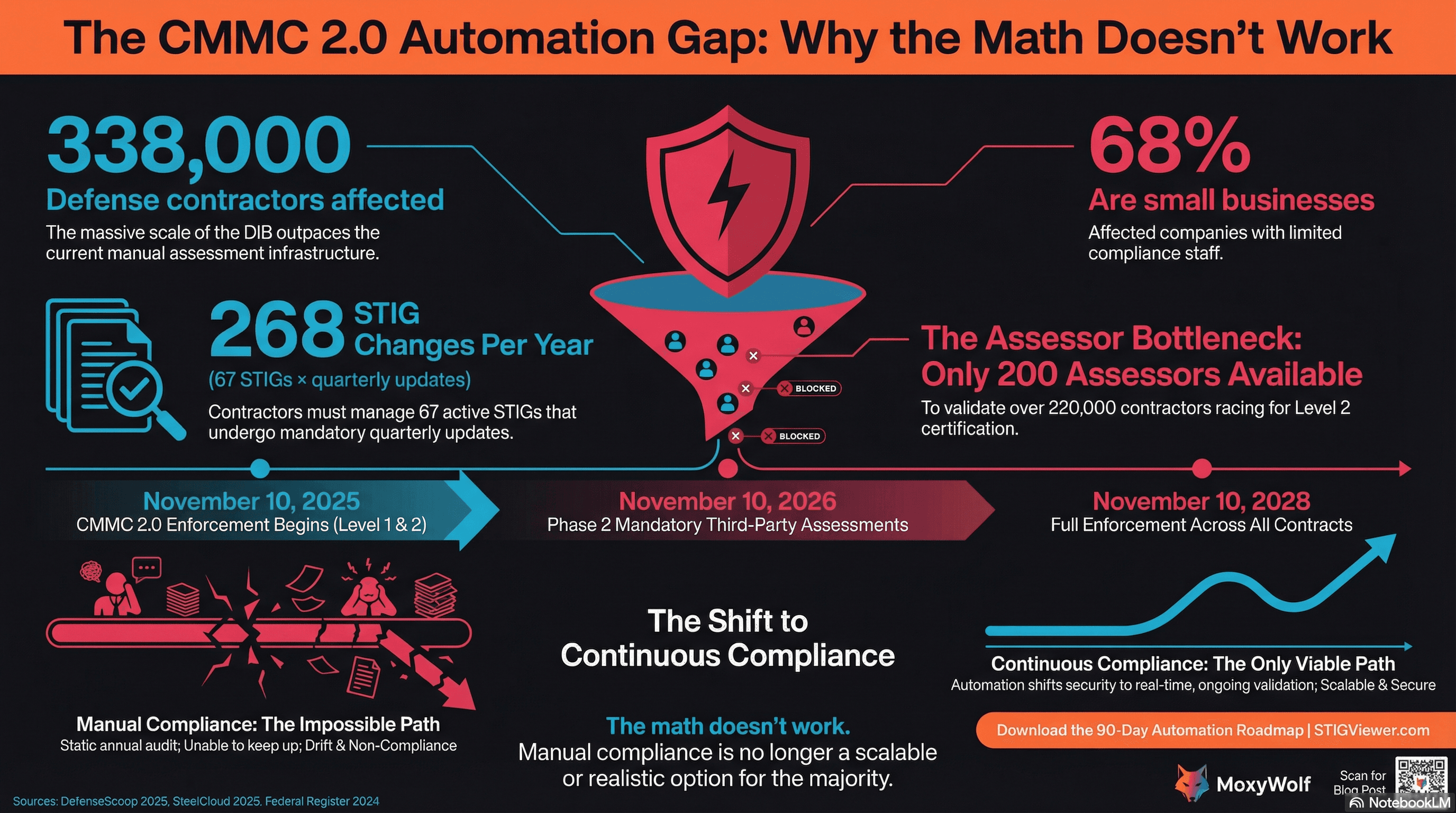
They want what they've always wanted – the contract, the certification, the trust that keeps the revenue flowing. Steel Patriot Partners (2025) describes STIGs as one of the few proven cybersecurity standards that can be fully automated. But here's the thing: most contractors aren't automated. They're managing 67 active STIGs manually. Each one updates quarterly. That's 268 changes per year across infrastructure that hasn't stopped growing since the pandemic.
The desire hasn't changed. Win contracts. Prove security. Sustain trust. But the obstacle has morphed into something the old playbook can't handle.
—-
November 10, 2025 changed everything. That's when CMMC 2.0 enforcement began – not as a suggestion, not as a future consideration, but as a contractual requirement affecting approximately 338,000 defense contractors. DefenseScoop (2025) reported that readiness gaps remain – which is one way to describe an industry where 68% of affected companies are small businesses with compliance teams of one or two people.
The Federal Register (2024) established the framework. But the Defense Federal Acquisition Regulation Supplement amendment made it real. Contracts now require CMMC Level 1 or Level 2 certification before award. Phase 2 mandatory third-party assessments begin November 10, 2026. The countdown isn't theoretical anymore.
SteelCloud (2025) isn't being subtle about what this means: automation is the only scalable path to CMMC Level 2. Manual evidence collection can't scale to 220,000 contractors racing toward the same certification deadline with roughly 200 assessors available to validate them all.
The math doesn't work. The old methods stopped scaling somewhere around STIG number twelve.
—-
Here's where the ecosystem reorganizes itself. DISA releases STIG updates quarterly. The Cyber.mil download page shows new releases every three months – SRGs, SCAP content, automated compliance files. But "released" doesn't mean "implemented." There's a gap between DISA publishing the standard and contractors deploying it, and that gap is where security posture lives or dies.
Amazon Web Services (2025) updated their managed STIG hardening components for the 2025 third quarter release across all compliance levels. Microsoft Azure Government has STIG automation GitHub repositories. The tools exist. The automation is possible. But adoption remains fragmented.
SteelCloud's ConfigOS MPO 2025.1 launched with clearer visibility, tighter validation, and a faster path to continuous compliance. The emphasis on *continuous* matters. Not point-in-time. Not annual audit. Continuous.
This is the battle being fought: checklist compliance versus continuous proof. The old model asked contractors to document controls once, submit evidence, pass audit, then... wait. The new model – the one CMMC 2.0 is forcing into existence – requires ongoing validation, real-time monitoring, automated remediation. And every quarter that passes without automation in place is another cycle of manual evidence collection that compounds the gap between where you are and where your assessor expects you to be.
Alston & Bird (2025) has been tracking the regulatory implications. The phased rollout isn't just about timeline – it's about how the compliance ecosystem itself is restructuring around continuous validation. Organizations still operating in point-in-time mode aren't just behind schedule. They're operating in a compliance paradigm that's being actively deprecated.
—-
The contractors who figure this out first aren't just compliant – they're competitive. They can bid on contracts that manual-compliance competitors can't touch. They can prove security posture in real-time instead of scrambling for documentation three weeks before assessment.
But the gap is widening. MAD Security's (2025) timeline analysis shows full enforcement hits November 2028. Every contractor, every contract, no exceptions. Between now and then, the ecosystem will sort itself into automated and obsolete.
The question isn't whether continuous compliance wins. It's whether your organization figures that out before your competitor does – and before DoD makes the decision for you.
—-
Sources:
- DefenseScoop (2025). "Pentagon Begins Enforcing CMMC Compliance, But Readiness Gaps Remain." https://defensescoop.com
- Federal Register (2024). "Cybersecurity Maturity Model Certification (CMMC) Program." https://www.federalregister.gov
- SteelCloud (2025). "Automate STIG Compliance In 2025 – Best Practices." https://www.steelcloud.com
- Steel Patriot Partners (2025). "Security Technical Implementation Guides (STIGs)." https://www.steelpatriotpartners.com
- Amazon Web Services (2025). "Amazon Managed STIG Hardening Components for Image Builder." https://aws.amazon.com
- Alston & Bird (2025). "CMMC: New Era of Cybersecurity Compliance for Defense Contractors." https://www.alston.com
- MAD Security (2025). "The 2025–2028 CMMC Rollout Timeline: What Defense Contractors Must Know." https://www.madsecurity.com