
stigviewer_convergence_report_2026-01-08
stigviewer_convergence_report_2026-01-08
Why Yesterday's C3PAO "Capacity Crisis" Reveals the Technical Foundation Defense Contractors Have Been Missing
Updated: January 8, 2026
—-
On January 7, 2026, Lazarus Alliance made an announcement that defense contractors need to pay attention to. The Cyber AB-accredited C3PAO (Certified Third-Party Assessment Organization) added 100+ CMMC Level 2 assessment slots for 2026, explicitly citing an "industry-wide capacity crisis" as contractors rush to secure assessments before Phase 2 enforcement begins November 10, 2026.
The language matters. When a major C3PAO uses the word "crisis" in a press release, that's not marketing hyperbole. Michael Peters, CEO of Lazarus Alliance, stated: "We recognize the real risk of delays that could jeopardize contract awards and supply chain continuity."
But here's what most defense contractors are missing: the C3PAO scheduling bottleneck isn't the problem. It's a symptom. The real problem is that 10 months before mandatory third-party assessments, most contractors aren't technically ready to pass one.
And technical readiness doesn't start with documentation or even CMMC frameworks. It starts with Security Technical Implementation Guides—the 20-year-old DoD standards that have quietly become the technical backbone of CMMC compliance.
The Perfect Storm: Three Forces Converging
What happens when the most granular cybersecurity checklist in government contracting collides with mandatory certification requirements and an assessment capacity shortage? For defense contractors and the Defense Industrial Base, the convergence of STIGs, CMMC 2.0 audits, and limited C3PAO availability represents a watershed moment—one that's reshaping how organizations approach cybersecurity compliance in 2026.[1][2]
The three forces:
- CMMC 2.0 Enforcement: Pentagon's rule took effect November 10, 2025, mandating certification for all contractors handling Federal Contract Information (FCI) or Controlled Unclassified Information (CUI)[2][3][1]
- C3PAO Capacity Constraints: Industry reports confirm wait times extending 3-6+ months, with approximately 80,000 defense contractors eventually needing Level 2 certification
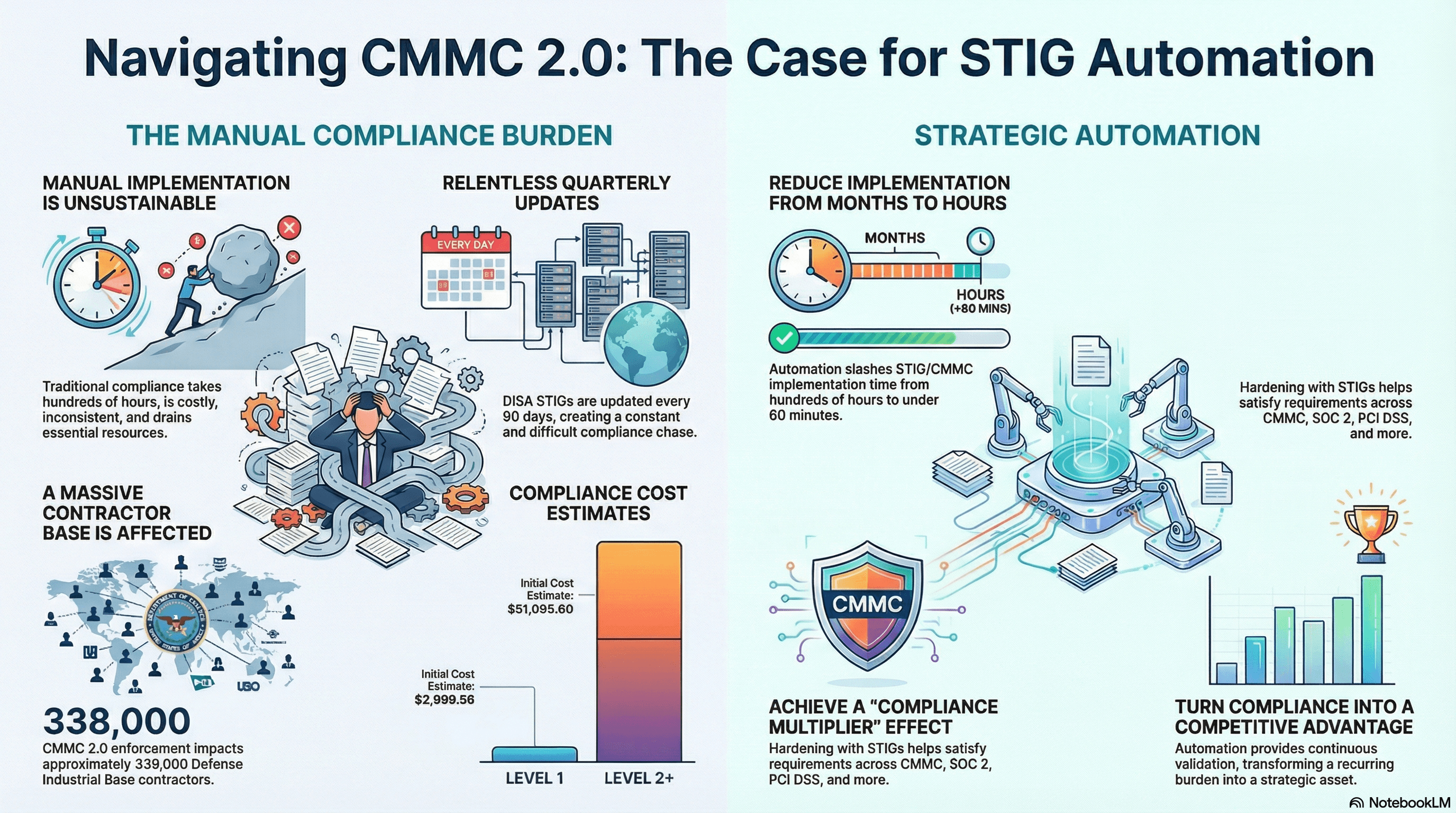
- STIG Technical Requirements: Over 490 different security checklists covering everything from Windows Server configurations (273 checks per server) to cloud platforms, updated quarterly by DISA[4][1]
The timing couldn't be more significant. Organizations scrambling to book C3PAO assessments are discovering that scheduling is downstream from a more fundamental challenge: establishing and maintaining automated STIG compliance that C3PAOs actually audit.
What C3PAOs Actually Verify During Assessments
CMMC Level 2 requires compliance with 110 security requirements in NIST SP 800-171 Revision 2. During a C3PAO assessment, auditors don't just review System Security Plan documentation. They verify technical implementation.
That verification happens at the STIG level.
STIGs provide the detailed, prescriptive security configurations that defense contractors need to demonstrate compliance with CMMC's control requirements. Developed by DISA, these guides offer the "how" to implement the "what" that CMMC frameworks require. When a C3PAO assessor checks whether you've implemented "access control" requirements, they're verifying specific technical settings:[5][1][4]
- Windows Server configurations match Windows Server 2022 STIG baselines (273 checks)
- SQL Server instances comply with SQL Server STIG requirements
- Red Hat systems meet Red Hat Enterprise Linux STIG specifications
- Network devices conform to applicable device STIGs
- IIS web servers satisfy up to 850 distinct security checks[3][4]
This isn't compliance philosophy. These are registry keys, configuration files, and security policies that assessors validate during the assessment.
The contractors booking C3PAO slots for Q3-Q4 2026 who haven't started STIG baseline work are booking assessments they're not prepared to pass.
Three Levels, One Technical Foundation
The CMMC 2.0 framework establishes three certification levels, each with distinct requirements:[3][2]
- Level 1: Self-assessment for contractors handling less sensitive FCI
- Level 2: Self-assessment or third-party assessment by C3PAO organizations for contractors managing CUI
- Level 3: Certification by the Defense Industrial Base Cybersecurity Assessment Center (DIBCAC) for the most sensitive CUI[2]
What makes STIGs invaluable across all three levels is their direct alignment with the NIST SP 800-171 controls that underpin CMMC Level 2 requirements. The Cybersecurity Maturity Model Certification framework essentially asks "what" security controls must be in place, while STIGs answer "how" to implement them technically.[5][1][4]
This convergence creates both challenge and opportunity. The challenge: manually implementing and maintaining STIG compliance across hundreds of requirements. The opportunity: automated STIG compliance simultaneously satisfies multiple regulatory requirements across the federal security ecosystem—including CMMC, FedRAMP cloud security, and NIST SP 800-53 controls.[1][4]
The Timeline Squeeze That Makes Automation Non-Negotiable
The phased implementation of CMMC 2.0 creates urgency for organizations to integrate STIGs into their security programs now. Yesterday's C3PAO announcement underscores just how compressed the timeline has become.
The Assessment Window:
- Phase 2 begins: November 10, 2026 (10 months from now)
- Current C3PAO wait times: 3-6+ months
- Assessment duration: 6+ weeks for Level 2
- Remediation window if conditional: 180 days maximum
- Technical preparation time remaining: 4-7 months
The Manual STIG Reality:
- Average environment: 50-200 systems requiring STIG compliance
- Windows Server 2022 STIG alone: 273 individual checks per server
- Red Hat Enterprise Linux STIG: 240+ requirements per system
- SQL Server, IIS, Chrome, Office applications: Each has separate STIGs
- DISA updates STIGs quarterly (every 90 days)
- Time per system for manual validation: 2-8 hours
- Remediation time per system: 4-12 hours (conservative estimate)
- Total manual effort: 6-12 months minimum
Most contractors don't have 6-12 months. They have 10 months until Phase 2, minus 3-6 months for C3PAO scheduling, minus 6 weeks for the assessment itself.
The math doesn't work without automation.
The rollout timeline creates additional pressure:[6][2]
- November 10, 2025: Initial CMMC requirements took effect with Level 1 self-assessments
- November 10, 2026: Phase Two begins, requiring Level 2 C3PAO certifications for designated contracts
- Annual recertification: Contractors must recertify their compliance status every year[3][2]
Organizations that fail to achieve compliance face disqualification from DoD contracts—a reality underscored by recent False Claims Act lawsuits against contractors who failed to meet cybersecurity requirements. The stakes extend beyond contract eligibility: government contracting officers now utilize the Supplier Performance Risk System (SPRS) to verify CMMC compliance before awarding contracts or executing extensions.[2][3]
Bridging the Gap: Modern STIG Automation
The complexity of simultaneously managing STIG compliance and CMMC certification has driven unprecedented demand for automation solutions. The convergence of quarterly STIG updates, annual CMMC audits, and shrinking preparation windows makes manual approaches unsustainable.
Modern STIG implementation now leverages:[1][4]
Security Content Automation Protocol (SCAP) Scanning Tools like SteelCloud's ConfigOS scan endpoint systems and remediate hundreds of STIG controls in under two minutes. The platform addresses Windows workstations/servers, SQL Server, IIS, browsers, Microsoft Office components, plus Red Hat, SUSE, CentOS, Ubuntu, and Oracle Linux systems.
Configuration Management Integration Puppet Enterprise with DISA STIG modules and Ansible with DISA Supplemental Automation Content establish STIG baselines across entire environments in hours instead of months. These tools create auditable paper trails tracking STIG configuration changes over time, drastically simplifying compliance assessment and demonstration.
Continuous Compliance Monitoring Manual point-in-time STIG validation creates a snapshot. But systems drift. Applications push updates. Administrators make changes. By the time your C3PAO assessment happens, your manually-validated baseline from 6 months ago may no longer be accurate.
Automation provides continuous monitoring. Configuration drift is detected and remediated automatically. Documentation updates in real-time. When the C3PAO assessor asks "show me current compliance status," you're showing actual current state, not a 6-month-old spreadsheet.
Automated Evidence Collection C3PAO assessments require extensive evidence: screenshots, configuration exports, validation reports, change logs, remediation documentation. Automated STIG tools generate this evidence continuously. Every scan produces a compliance report. Every remediation creates an audit trail.
Contractors trying to manually generate this evidence during assessment prep discover it takes weeks of full-time work just to compile documentation. Those with automated platforms arrive at assessments with evidence packages already complete.
Risk-Based Prioritization and POA&Ms
Organizations implementing STIGs effectively employ a risk-based prioritization approach, addressing Category I (high-severity) vulnerabilities first before tackling medium and low-severity issues. This methodology aligns perfectly with CMMC's risk management philosophy and enables contractors to demonstrate concrete progress during assessments.[4][1]
One of CMMC 2.0's most significant policy innovations supports this phased approach: the introduction of Plans of Action & Milestones (POA&Ms) for contractors at Levels 2 and 3. Organizations that don't fully meet certification standards can receive conditional certification for up to 180 days by submitting detailed remediation plans.[3][4][2]
This flexibility creates a practical pathway for contractors working through complex STIG implementations. The POA&M provision acknowledges the reality that comprehensive STIG compliance is a journey, not a destination. It provides breathing room for contractors to address gaps systematically while maintaining contract eligibility—but only if they can demonstrate concrete progress and realistic timelines.[4][2]
The strategic sequence that works:
- Establish automated STIG compliance (foundation)
Deploy SCAP-compliant automation platform, load current DISA STIG content, run baseline scans
- Execute risk-based remediation (proof)
Address CAT I findings immediately, automate CAT II/III remediation, validate fixes
- Enable continuous monitoring (maintenance)
Configure drift detection, automate re-remediation, maintain compliance through quarterly updates
- Generate assessment evidence (documentation)
Automated compliance reports, audit trails, configuration snapshots, remediation logs
- Book C3PAO assessment (validation)
Schedule with confidence, provide evidence packages, demonstrate continuous compliance
- Pass assessment on first attempt (certification)
Technical proof validates documentation, conditional POA&M if needed, annual recertification streamlined
Reversing this sequence—booking the C3PAO assessment before establishing technical compliance—creates a different outcome: scrambling for manual STIG validation, discovering gaps during prep, requesting delays or failing with conditional status, spending 180 days on remediation (if you get another chance), jeopardizing contract eligibility.
The Broader Security Ecosystem and Compliance Multiplier Effect
STIGs integration with CMMC extends beyond DoD requirements to touch other critical compliance frameworks. Organizations implementing STIGs to support CMMC certification often find themselves simultaneously advancing:[1][4]
- FedRAMP cloud security compliance with consistent baseline configurations
- NIST Special Publication 800-53 controls through direct STIG mappings
- Risk Management Framework (RMF) authorization packages with automated evidence
- ISO 27001 security controls through standardized technical implementations
This convergence creates efficiency gains: a single STIG automation implementation effort can satisfy multiple regulatory requirements across the federal security ecosystem. The "compliance multiplier" effect means contractors aren't just checking CMMC boxes—they're building genuine security postures that serve multiple frameworks simultaneously.
The ripple effects extend to sectors beyond defense contracting. Healthcare organizations protecting patient data, higher education institutions safeguarding research information, and state and local government entities are increasingly adopting STIGs as best practices—even without explicit CMMC obligations.[4]
The Competitive Dynamics That Yesterday's Announcement Revealed
Lazarus Alliance's January 7th announcement didn't just signal C3PAO capacity issues. It revealed that defense contractors are finally understanding Phase 2 urgency—but many are approaching it backwards.
The competitive advantage now belongs to contractors who understand this insight:
C3PAO assessment scheduling isn't the bottleneck if you're not technically ready to pass the assessment.
Defense contractors who understand what the "capacity crisis" announcement actually means have significant competitive advantages:
While competitors scramble to book C3PAO slots, technically prepared contractors are:
- Booking assessments with confidence they'll pass on first attempt
- Spending prep time on documentation refinement, not configuration firefighting
- Generating continuous assessment evidence instead of manual documentation compilation
- Maintaining compliance through quarterly STIG updates without disruption
- Compressing the assessment-to-certification window from months to weeks
More importantly, they're not experiencing the assessment delay and remediation cycle that creates contract award gaps.
When Phase 2 enforcement begins November 10, 2026, DoD contracts will require Level 2 (C3PAO) certification as a condition of award. Contractors without current certification lose bidding eligibility. The window between "booking assessment" and "achieving certification" includes preparation time, assessment time, and potential remediation time.
Contractors who started STIG automation work months ago compressed that window dramatically. Contractors starting STIG automation work today still have time—barely—to be ready for Q4 2026 assessments. Contractors who wait until they've booked their C3PAO slot to begin STIG compliance work won't have enough time to prepare.
Market Consolidation Effects
Industry analysis predicts 15-20% of the Defense Industrial Base—approximately 33,000 to 44,000 companies—will exit the defense market between 2025 and 2027, with the majority of exits occurring in 2026 as Phase 2 implementation begins. This consolidation isn't theoretical. It's happening now, driven by contractors who cannot achieve or maintain the technical compliance that C3PAOs actually audit.
The requirement for 72-hour incident reporting, mandatory SPRS compliance monitoring, and annual recertification creates an environment where security is truly continuous rather than periodic.[5][6][2][3] This operational reality favors organizations with automated compliance capabilities over those attempting manual approaches.
What to Do This Week
Yesterday's announcement should trigger immediate action. January 7's "capacity crisis" was a market signal. Here's the strategic response:
Action 1: Assess Current STIG Compliance Status
Before booking a C3PAO assessment slot, know your technical posture:
- Which systems in your environment require STIG compliance?
- Which STIG versions apply to each system?
- What's your current compliance percentage per STIG?
- Where are your configuration gaps?
Automated STIG scanning tools answer these questions in hours. Manual assessment takes weeks.
Action 2: Implement Automated STIG Compliance
If you're not running automated STIG validation and remediation, start now:
- Evaluate SCAP-compliant automation platforms (ConfigOS, Puppet, Ansible with DISA content)
- Prioritize systems that handle CUI first
- Establish automated baseline configurations
- Enable continuous monitoring and drift detection
- Configure automated evidence collection
This work should start immediately, not when you book your C3PAO assessment.
Action 3: Map STIG Compliance to NIST 800-171 Controls
C3PAO assessors validate NIST 800-171 compliance. STIGs provide technical proof of that compliance. Document the mapping:
- Which NIST 800-171 controls require STIG implementation?
- Which STIG requirements satisfy which 800-171 controls?
- Where does your STIG compliance provide assessment evidence?
This mapping becomes part of your System Security Plan. It shows C3PAO assessors that your technical configurations directly support required security controls.
Looking Forward: The New Normal
As we move through 2026, the integration of STIGs and CMMC 2.0 audits represents more than a compliance checkbox—it signals a fundamental shift toward measurable, auditable cybersecurity practices across the defense supply chain. Yesterday's C3PAO announcement confirms this shift is accelerating.
The requirement for continuous compliance, annual recertification, quarterly STIG updates, and limited C3PAO capacity creates an environment where automation isn't optional—it's the only scalable approach. Organizations treating STIGs as burdensome checklists will struggle. Those treating STIGs as the technical roadmap to CMMC compliance—and leveraging automation to implement that roadmap efficiently—will find themselves not just compliant, but genuinely more secure.
The bottom line: Yesterday's Lazarus Alliance announcement about C3PAO capacity crisis is a market signal. Defense contractors are waking up to Phase 2 urgency. But C3PAO scheduling is downstream from technical readiness. And technical readiness starts with STIG compliance automation.
For contractors and organizations in the Defense Industrial Base, success requires mastering this convergence—leveraging automation, prioritizing risks effectively, maintaining robust change management processes, and generating continuous evidence that C3PAOs can audit with confidence.[1][4]
The contractors who will successfully navigate CMMC Phase 2 aren't the ones who booked C3PAO assessments fastest. They're the ones who established automated STIG compliance earliest.
Ten months until Phase 2. Three to six months for C3PAO scheduling. That leaves 4-7 months for technical preparation, assessment completion, and potential remediation.
The timeline works if you start STIG automation now. It doesn't work if you're planning to start after you've booked your assessment.
—-
Additional Resources
Free 90-Day C3PAO Readiness Checklist Complete STIG automation implementation plan with phased action items, platform evaluation criteria, and evidence collection templates. Download at: STIGViewer.com/readiness
STIGViewer Platform Automated STIG validation tools used by 35,000+ weekly visitors from defense contractors, federal agencies, and compliance professionals. Access at: STIGViewer.com
—-
Sources
[1] Security Technical Implementation Guides (STIGs): The Essentials. Steel Patriot Partners. https://resources.steelpatriotpartners.com/security-technical-implementation-guides-stigs
[2] Pentagon to officially implement CMMC 2.0 requirements in contracts by Nov 10. Clark Hill PLC. https://www.clarkhill.com/news-events/news/pentagon-to-officially-implement-cmmc-2-0-requirements-in-contracts-by-nov-10/
[3] Compliance as Structured Knowledge. Internal technical documentation.
[4] AssessITS: Integrating procedural guidelines and practical evaluation metrics for organizational IT and Cybersecurity risk assessment. arXiv:2410.01750. http://arxiv.org/pdf/2410.01750.pdf
[5] CMMC Compliance: What You Need to Know Heading Into 2026. Fortra. https://www.fortra.com/blog/cmmc-compliance-what-you-need-know-heading-2026
[6] Why CMMC compliance may matter for your company in 2026. Integris IT. https://integrisit.com/blog/why-cmmc-compliance-may-matter-for-your-company-in-2026/
—-
Document Version: 2.0 Last Updated: January 8, 2026 Original Publication: December 2025 Next Review: January 15, 2026 (following any additional C3PAO capacity announcements)
—-
*This analysis incorporates breaking developments from the January 7, 2026 Lazarus Alliance C3PAO capacity announcement with ongoing strategic analysis of STIG-CMMC convergence. For weekly updates on CMMC implementation, STIG releases, and defense contractor compliance requirements, visit STIGViewer.com.*