
847 Findings, Zero Context: When Continuous Compliance Outran the Humans Running It
847 Findings, Zero Context: When Continuous Compliance Outran the Humans Running It
The automation isn't failing. The humans interpreting it are drowning. And your C3PAO doesn't care which one broke first.
—-
Twelve weeks into CMMC 2.0 Phase 1, and something uncomfortable is happening. Defense contractors spent years begging for automation. They got it. STIG scanning platforms now detect misconfigurations in seconds. Auto-remediation scripts fix firewall rules before the security team finishes their morning standup. Dashboards glow green. Executives exhale.
Then the C3PAO assessor walks in.
"Show me the change approval ticket for that remediation. Who validated it didn't break production? Where's the evidence this control stayed in place for the full assessment period?"
Silence.
—-
The Evidence Gap Nobody Advertised
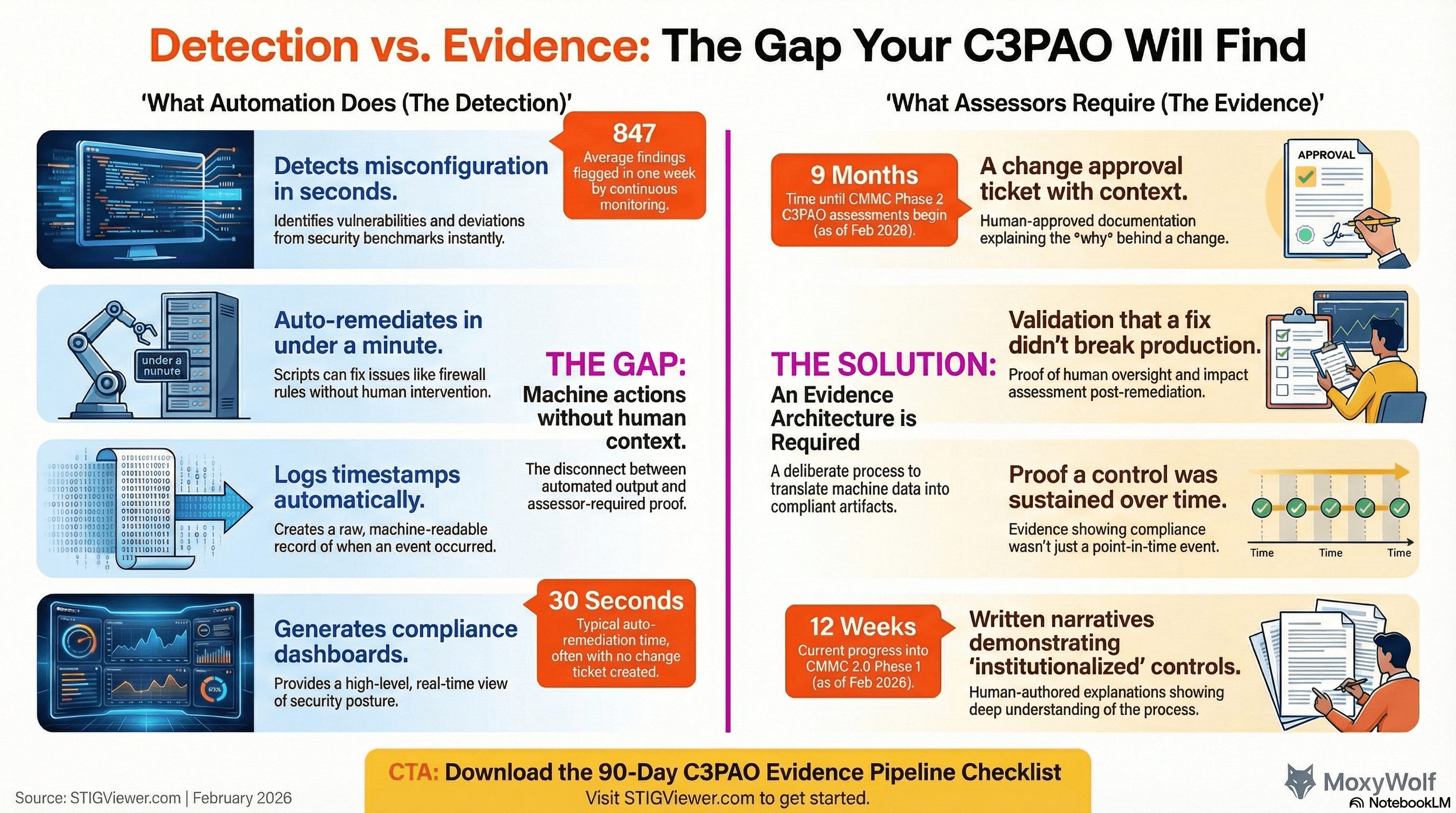
Here's the tension SteelCloud (2026) is circling in their recent arguments that manual compliance fails cyber readiness: they're right that quarterly reviews can't match the pace of AI-multiplied threat reconnaissance. Point-in-time assurance died somewhere around the third zero-day of the month. But the pitch for continuous compliance glosses over a brutal operational reality – machines generate findings faster than humans can validate, contextualize, or remediate them.
Your automation platform catches a misconfigured access control in 30 seconds. Beautiful. It auto-remediates, logs the change, timestamps everything. But CMMC 2.0 assessments still demand human judgment. Written narratives. Contextual evidence that a control isn't just technically present at the moment a script ran – it's "institutionalized." That word matters. It means someone understood *why* the control exists, verified the fix didn't cascade into three other systems, and documented the whole thing in language an assessor can follow.
The real gap isn't between manual and automated compliance. It's between machine-generated actions and assessor-legible artifacts. And right now, most organizations are automating configuration management while still manually assembling compliance packages. They've upgraded the engine but left the transmission in first gear.
—-
When Visibility Becomes Noise
Picture this: your continuous monitoring platform flags 847 new findings this week. Most are INFO and LOW severity STIG deviations – the kind that technically violate a benchmark but don't represent meaningful risk. How many does your security team actually investigate?
Be honest.
SteelCloud (2026) argues every industry needs a STIG-level security mindset, and they're not wrong about the destination. But continuous monitoring without intelligent triage just relocates the problem. You haven't eliminated false confidence – you've replaced it with alert fatigue. That dashboard showing 800 open findings? Your assessor's going to ask which ones actually matter. And "we have 24/7 visibility" isn't the same answer as "we have 24/7 actionable intelligence with realistic remediation workflows."
The threshold where comprehensive visibility becomes compliance theater is lower than anyone wants to admit. When your team starts ignoring LOW findings because there are too many to investigate, you've trained them to miss the one that isn't low. That's not continuous compliance. That's continuous documentation of your inability to keep up.
Risk-based prioritization isn't a feature toggle. It's an operational discipline that requires someone – a human someone – to decide what "material" means in context. Which 47 of those 847 findings represent actual exploitable paths? Which ones can wait until next quarter? And who's accountable when the one you deprioritized turns out to be the entry point?
—-
The Messy Middle Is Where Everyone Actually Lives
No organization flips a switch from quarterly manual audits to fully automated, continuously validated security posture. The transition is messy. Expensive. Politically complicated in ways vendors never mention in demos.
Legacy systems that can't be auto-remediated without breaking production – they're still running, still in scope, and still generating findings your platform flags but can't fix. Security teams learning new tooling while simultaneously responding to the same incident load they had before the "efficiency upgrade." Budget fights where "compliance automation" competes against "actual security capabilities" as if those are different line items.
And then there's the vendor problem. Platforms sold as turnkey that require six months of custom integration before they produce useful output. Defense contractors discovering that "out-of-the-box CMMC support" means the tool can generate a report, not that the report satisfies an assessor.
This is where 220,000+ defense contractors actually live right now. Phase 1 requires evidence of systematic practices. Most organizations are still stitching together scanning tools, spreadsheet trackers, and manual evidence collection with whatever held the last audit together. Phase 2 C3PAO assessments start in November 2026. That's nine months to operationalize what sales teams are calling "turnkey."
Nine months. For an operational transformation. While simultaneously maintaining the security posture that operational transformation is supposed to improve.
—-
What "Good Enough" Actually Requires
The path forward isn't a procurement decision. It's three simultaneous engineering problems most organizations haven't fully scoped.
First: evidence architecture. Machine-generated findings have to feed into documentation workflows that produce assessor-legible artifacts. Not raw logs. Not automated screenshots. Structured narratives that demonstrate understanding, intent, and sustained implementation. If your automation can detect and fix a misconfiguration but can't explain to a C3PAO why the fix was appropriate, you've built half a bridge.
Second: intelligent triage. The 847-finding problem doesn't solve itself with more automation – it solves itself with better filtering. Risk-based prioritization that distinguishes signal from noise, maps findings to actual threat vectors, and sequences remediation against realistic capacity. Your team can fix twelve critical issues this week. Not twelve hundred.
Third: honest timelines. Automation handles what it handles. Human validation covers what it must. And somewhere between those two, there's a gap that requires organizational honesty about what "assessment-ready" looks like at each stage of maturity. Not the vendor's timeline. Yours.
—-
SteelCloud's core argument holds. AI-accelerated threats and condensed attack timelines have broken the quarterly audit model. Continuous compliance is the right destination.
But the journey? The journey involves nine months of building evidence pipelines that don't exist yet, training teams on tools they're still configuring, and making triage decisions that no vendor dashboard will make for you. And every week that passes without that operational foundation, the gap between "we have automation" and "we can prove compliance" gets wider.
The question isn't whether your organization automates. It's whether you figure out the messy middle – the evidence architecture, the intelligent triage, the human-machine handoff – before November 2026. Or whether your C3PAO assessor figures it out for you.
—-
Sources
- SteelCloud – "Manual Compliance Fails Cyber Readiness in 2026" (2026) – https://www.linkedin.com/posts/steelcloud_manual-compliance-%3F%3F%3F%3F%3F-responsible-activity-7418008816136556544-IkTl
- SteelCloud – "Why Every Industry Needs a STIG-Level Security Mindset" (2026) – https://www.linkedin.com/posts/steelcloud_why-every-industry-needs-a-stig-level-security-activity-7419438050482520064-do2Z
- "Compliance as Structured Knowledge" – Research Collection (2025) – https://ppl-ai-file-upload.s3.amazonaws.com/web/direct-files/collection_6c9b3593-12c2-4e4f-a581-afd6857be915/eba9d370-c526-4a4c-9232d1a31095539/compliance-as-structured-knowledge.md